If you’ve ever stepped into a spray painting booth shop—whether it’s a small auto body repair garage or a mid-sized industrial equipment finishing facility—you’ve probably noticed two things: the gentle hum of filtered air, and stacks of white, felt-like pads stacked near the entry to the booth. For years, I’ve been on the front lines of supporting spray booth operators, fielding calls from techs who ask why their booth’s airflow dips mid-project, or why their finish has tiny, gritty spots they can’t explain. More often than not, the answer boils down to mixing up spray booth pre-filters vs. main filters. As a spray painting booth supplier who’s installed hundreds of these systems across North America, I’ve learned that these two parts aren’t interchangeable—they’re a team, and skipping either, or using the wrong one, is one of the most avoidable, costly mistakes operators make. Spray Painting Booth
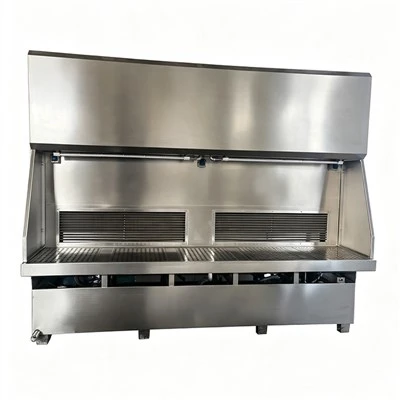
Let’s start with the basics: what each filter does, because their design is tied directly to their job. Pre-filters sit at the booth’s air intake, the first stop for unfiltered ambient air pulled in to circulate through the spray chamber and exhaust pollutants. Their job is coarse: they catch big, visible debris—dust bunnies from the shop floor, wood shavings from nearby carpentry, rust flecks from old auto frames, even pollen and lint from dirty drop cloths. These are the particles that would never make it all the way to the main filter, and if they did, they’d clog the main filter way faster than it should. Pre-filters are usually made from a loose, polyester or cotton blend, with a wide, open weave that lets air pass through easily but snags any particle larger than 10 microns (that’s about the size of a fine grain of sand). They’re disposable, lightweight, and cheap enough to replace weekly for most high-use booths.
Main filters, on the other hand, live deep inside the booth’s filtration system, downstream from the pre-filter. Their job is far more precise: they catch fine airborne contaminants, overspray paint mist, and volatile organic compound (VOC) particles that the pre-filter would miss. Most main filters used in spray booths are HEPA (High-Efficiency Particulate Air) filters or, for industrial applications, bag filters with a MERV (Minimum Efficiency Reporting Value) rating of 16 to 18, meaning they capture 95% to 99.97% of particles as small as 0.3 microns. Their dense, layered design (usually a pleated glass fiber media) means they catch every leftover contaminant before clean air is recirculated back into the shop or vented outside. That precision comes at a cost: main filters are heavier, more durable, and far more expensive to replace than pre-filters.
The biggest misconception I hear all the time is that you can use a pre-filter in place of a main filter, or vice versa. I remember a call two years ago from a small auto shop in Ohio: their techs were using cheap, generic pre-filters as main filters, thinking “a filter’s a filter.” Within three weeks, their booth airflow dropped by 40%. When we inspected the filter, the loose weave of the pre-filter had become compacted with fine paint particles, blocking so much air that the spray gun wasn’t getting enough consistent airflow. Worse, those fine paint particles that slipped through had settled on the finish of two customer cars, requiring full buffing and repainting—costing them over $2,000 in labor and materials. That’s the problem with mixing these two: their design, particle capture range, and replacement schedule are non-negotiable.
Let’s break down their distinct roles even further, because understanding that difference is what saves you money and improves finish quality. The pre-filter is the unsung first line of defense. Think of it like a screen door for your booth: it keeps the big, obvious dirt out so the main filter can do the delicate work. Without a pre-filter, the main filter has to handle every particle, even the ones that don’t matter for finish quality (like dust from the shop floor). That not only clogs the main filter faster but also shortens its lifespan dramatically. I’ve seen main filters that should last 6 months need replacement every 6 weeks just because they didn’t have a pre-filter in place.
The main filter is the finishing touch’s best friend. Even if your pre-filter does its job perfectly, overspray mist and tiny paint particles (some as small as a speck of smoke) will still float through the air. If those particles land on your wet spray paint, they create tiny, uneven spots that ruin the finish. I once visited a large industrial equipment plant in Michigan where they switched from a standard pre-filter-only system to a proper pre-main filter combo. Their defect rate on new equipment finishes dropped from 8% to less than 1% in the first month—saving them over $15,000 a year in rework. That’s not a small number; that’s the difference between turning a profit on a big job and losing it.
Replacement schedules are another key point where pre-filters and main filters differ. Pre-filters need to be changed much more frequently, and that frequency depends on your booth’s use. For a busy auto body shop running 8 hours a day, 5 days a week, a pre-filter will get clogged with dust, paint overspray, and lint in 7 to 10 days. If you’re spraying heavily pigmented paints (like red or black, which leave more visible residue), you might even need to swap them every 5 days. The good news is pre-filter replacements are quick: they slide into a frame on the booth’s intake, take 2 minutes to change, and cost a fraction of a main filter. I always tell techs to check their pre-filter weekly—if it’s visibly gray, caked with debris, or airflow feels weaker than usual, it’s time to replace it.
Main filters, by contrast, last much longer. For standard spray booths, a good main filter should last 6 to 12 months, depending on use. You’ll know it’s time to replace it when your booth’s airflow drops below the manufacturer’s recommended level (usually marked on the booth’s control panel, around 100 feet per minute for most spray chambers) or if you notice tiny particles in your finish that the pre-filter didn’t catch. Some industrial booths, which run 24/7, might need main filter changes every 3 to 4 months, but that’s still far less frequent than pre-filters.
Now, let’s talk about common mistakes that people make with these filters, because avoiding them is where the value really comes in. The first mistake is skipping pre-filters entirely. Some operators think they can save money by only buying main filters, but as we saw with that Ohio auto shop, that backfires fast. The main filter becomes a dust catcher, not a fine contaminant catcher, and you end up paying for expensive main filter replacements every few weeks instead of cheap pre-filter swaps every week. Another mistake is using the wrong pre-filter. Not all pre-filters are equal: a cheap, thin pre-filter will clog way faster than a heavy-duty, polyester pre-filter designed for spray booths. I recommend 10-micron rated pre-filters for most booths—any finer and you’ll block too much air, any coarser and you’ll let debris through.
A third big mistake is not sealing filters properly when replacing them. Both pre-filters and main filters need to fit tight in their frames, with no gaps around the edges. Even a tiny gap (1/8 of an inch) can let unfiltered air or debris slip through, ruining your finish. I’ve seen techs skip taping the edges of filters, only to find that over a week, dust was seeping through the gap and landing on their work. It’s a 10-second step that makes a huge difference.
Another mistake people make is waiting too long to replace pre-filters. When a pre-filter is clogged, it restricts airflow, which makes your spray gun work harder. That leads to uneven spray patterns, more overspray, and longer spray times—wasting paint and increasing labor costs. A 2022 study from the Spray Equipment and Finishing Association (SEFA, one of the leading industry groups for spray booth systems) found that clogged pre-filters can increase paint waste by up to 15% per job. Multiply that over a year, and you’re looking at thousands of dollars in wasted material.
So, how do you build a proper filtration system for your spray booth? It’s pretty simple: start with a good pre-filter, rated for 10 to 12 microns, installed at the booth’s air intake. Check it weekly, replace as needed. Then pair it with a main filter rated for HEPA or MERV 16+, sized to match your booth’s airflow requirements. For most standard booths, that means a 20x20x1 inch pre-filter and a 24x24x12 inch pleated main filter, but always check your booth’s manual for exact sizing. And never, ever skip either part.
As a spray booth supplier, I’ve worked with hundreds of operators to set up their filtration systems, and the ones who prioritize pre-main filter pairs consistently have fewer rework jobs, lower material costs, and longer equipment lifespans. I once had a customer in Chicago who ran a custom furniture shop—they used to have to sand and repaint 5 out of every 10 dining tables, because of spots from airborne debris. After switching to a proper pre-filter and main filter combo, their defect rate dropped to less than 1 out of 20 tables, and they saved over $12,000 a year in rework. That’s not a small win for a small business.
Wastewater Treatment Equipment If you’re still unsure about your current system—whether you’re using the wrong filters, replacing them on the wrong schedule, or dealing with constant finish defects—we’re here to help. Whether you need a pre-filter upgrade, a main filter replacement, or a full assessment of your spray booth’s filtration system, our team can walk you through the best options for your specific setup. Don’t let avoidable mistakes cost you money or hurt your reputation with customers. Reach out today to discuss your filtration needs, and we’ll help you build a system that keeps your finishes clean, your airflow consistent, and your operations running smoothly.
References
- Spray Equipment and Finishing Association. (2022). Best Practices for Spray Booth Filtration Systems. SEFA Industry Guidelines.
- National Institute for Occupational Safety and Health. (2021). Contaminant Control in Spray Painting Booths. NIOSH Publication 2021-12.
- Automotive Service Association. (2020). Auto Body Finish Quality: The Impact of Proper Filtration. ASA Technical Bulletin.
- Industrial Ventilation: A Manual of Recommended Practice. (2019). American Conference of Governmental Industrial Hygienists.
- Global Finishing Solutions. (2022). Spray Booth Maintenance Guide: Filter Replacement Schedules and Best Practices. GFS Technical Resources.
Ningbo Jialong Energy-saving and Environmental Protection Technology Co., Ltd.
As one of the most professional spray painting booth manufacturers and suppliers in China, we also support customized service. We warmly welcome to buy advanced spray painting booth in stock here from our factory. If you have any enquiry about quotation, please feel free to email us.
Address: Dong Village, Dongwu Town, Yinzhou District, Ningbo City, Zhejiang Province (No.63 Zhennan Road, Dongwu Town)
E-mail: Lin.cx@nb-jalo.com
WebSite: https://www.cnjialong.com/
